Annual Reports
AT&T Inc.'s annual reports contain management's most considered account of the business. These are the sections, passages and visual pages worth opening in the originals preserved in Sources.
AT&T Inc. — FY2025 Annual Report (Form 10-K) — FY2025
The current AT&T: a pure connectivity company built on 5G and fiber, with the WarnerMedia and DIRECTV chapters closed and pending Lumen fiber and EchoStar spectrum deals ahead. · Open the full document →
Item 1. Business — General and Areas of Focus — p. 6 · Read the full section →
Management's own framing of the post-media strategy: a converged 5G-plus-fiber network, copper decommissioning, and the pending Lumen and EchoStar transactions.
Strategy stated plainly: lead in connectivity through 5G and fiber, and grow fiber organically and via Lumen and EchoStar.
We are a leader in providing connectivity services through our market focus areas of 5G and fiber. Fiber underpins the connectivity we deliver, both wired and wireless. Building on that fiber foundation is our solid spectrum portfolio, strengthened through Federal Communications Commission (FCC) auctions, other spectrum acquisitions and 5G deployment. […] We will also focus on accelerating our fiber expansion, organically and through our pending acquisition of substantially all of Lumen’s Mass Markets fiber business. We will continue to deploy low- and mid-band spectrum to improve speed and capacity, including spectrum to be acquired from our pending transactions with EchoStar Corporation (EchoStar) and other spectrum acquisitions.
p. 8 · Read in context →
Item 1. Business — Operating Segments — p. 10 · Read the full section →
How AT&T actually makes money now: two segments, with Communications (Mobility, Business Wireline, Consumer Wireline) at ~97% of revenue and 120 million Mobility subscribers.
The Communications segment and its three business units; 120 million Mobility subscribers at year-end 2025.
Our Communications segment provides wireless and wireline telecom and broadband services to consumers located in the United States and businesses globally. […] This segment contains the Mobility, Business Wireline and Consumer Wireline business units. […] As of December 31, 2025, we served 120 million Mobility subscribers, including 91 million postpaid (74 million phone), 18 million prepaid and 11 million through resellers.
p. 10 · Read in context →
Item 1A. Risk Factors — Company-Specific Financial Factors — p. 24 · Read the full section →
The two risks most specific to AT&T that could genuinely bite: cyberattacks (the July 2024 customer-data incident) and the debt taken on to fund spectrum and acquisitions.
Debt raised for acquisitions and spectrum has already driven credit-rating downgrades from historical levels.
We intend to and have incurred debt to fund significant acquisitions, as well as spectrum purchases needed to compete in our industry. While we believe such decisions were prudent and necessary to take advantage of both growth opportunities and respond to industry developments, we did experience credit rating downgrades from historical levels.
p. 30 · Read in context →
Item 7. MD&A — Results of Operations — p. 39 · Read the full section →
Management explains what drove 2025: revenue up 2.7% to $125.6B on Mobility and Consumer Wireline, operating income up 26.8% as the prior-year goodwill impairment washed out.
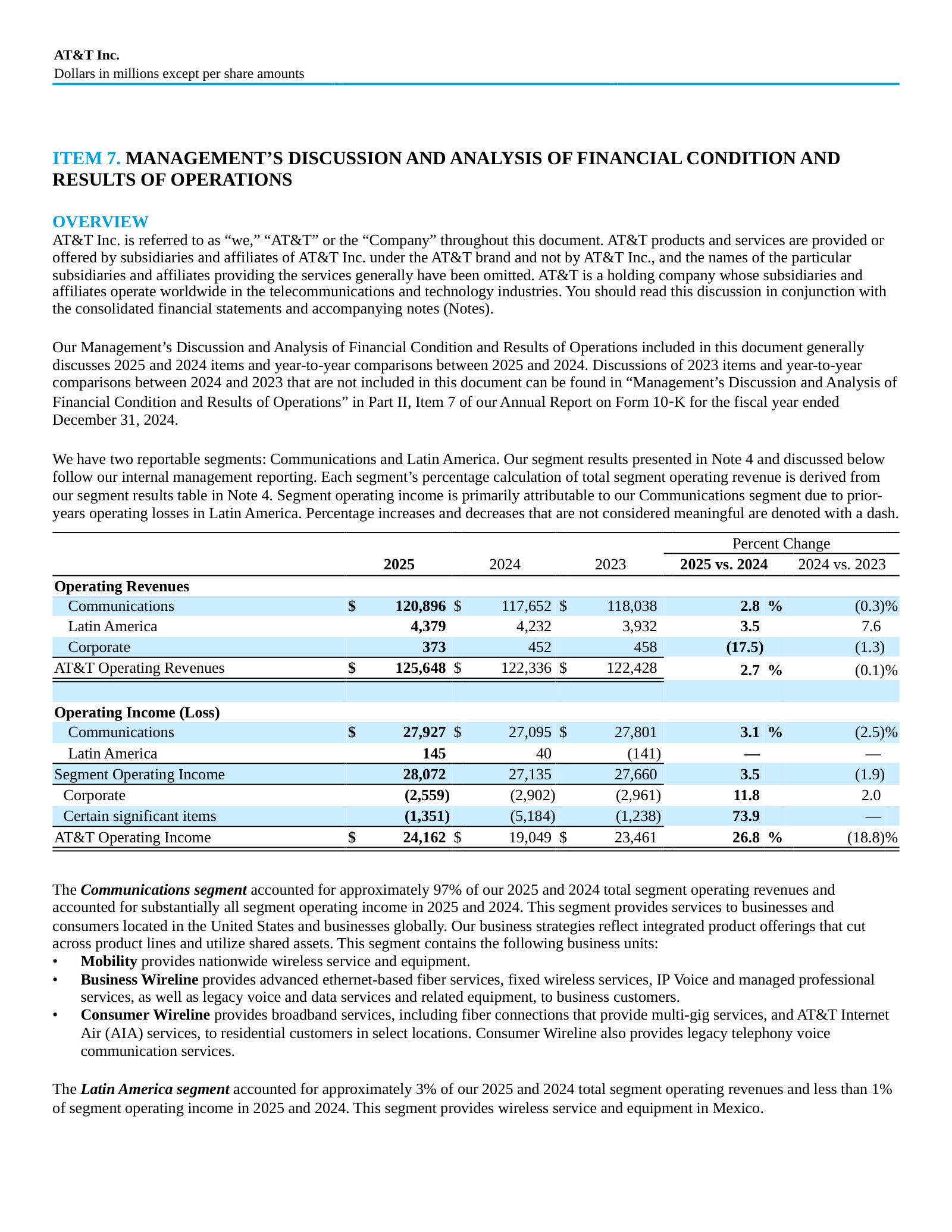
The revenue mix and the margin swing: operating margin 19.2% in 2025 versus 15.6% in 2024.
Operating revenues increased in 2025, reflecting higher Mobility and Consumer Wireline revenues, partially offset by declines in Business Wireline. Operating revenues in Mexico were also higher, overcoming unfavorable foreign exchange impacts during the first half of 2025. […] Our operating margin was 19.2% in 2025, compared to 15.6% in 2024, and 19.2% in 2023.
p. 41 · Read in context →
Item 7. MD&A — Liquidity and Capital Resources — p. 60 · Read the full section →
The cash-and-debt story at the center of the AT&T thesis: $40.3B operating cash flow, $136.1B total debt, and a cash pile built up for pending deals.
Year-end cash swelled to $18.2B ahead of announced transactions; the DIRECTV disposition and receivables sales fed inflows.
We had $18,234 in cash and cash equivalents available at December 31, 2025, increasing $14,936 since December 31, 2024. […] Our cash and cash equivalents at December 31, 2025 was elevated in anticipation of the consummation of announced transactions. […] In 2025, cash inflows were primarily provided by cash receipts from operations, including cash from our sale and transfer of our receivables to third parties, and the disposition of our investment in DIRECTV.
p. 60 · Read in context →
Item 7. MD&A — Discussion and Reconciliation of Non-GAAP Measures — p. 66 · Read the full section →
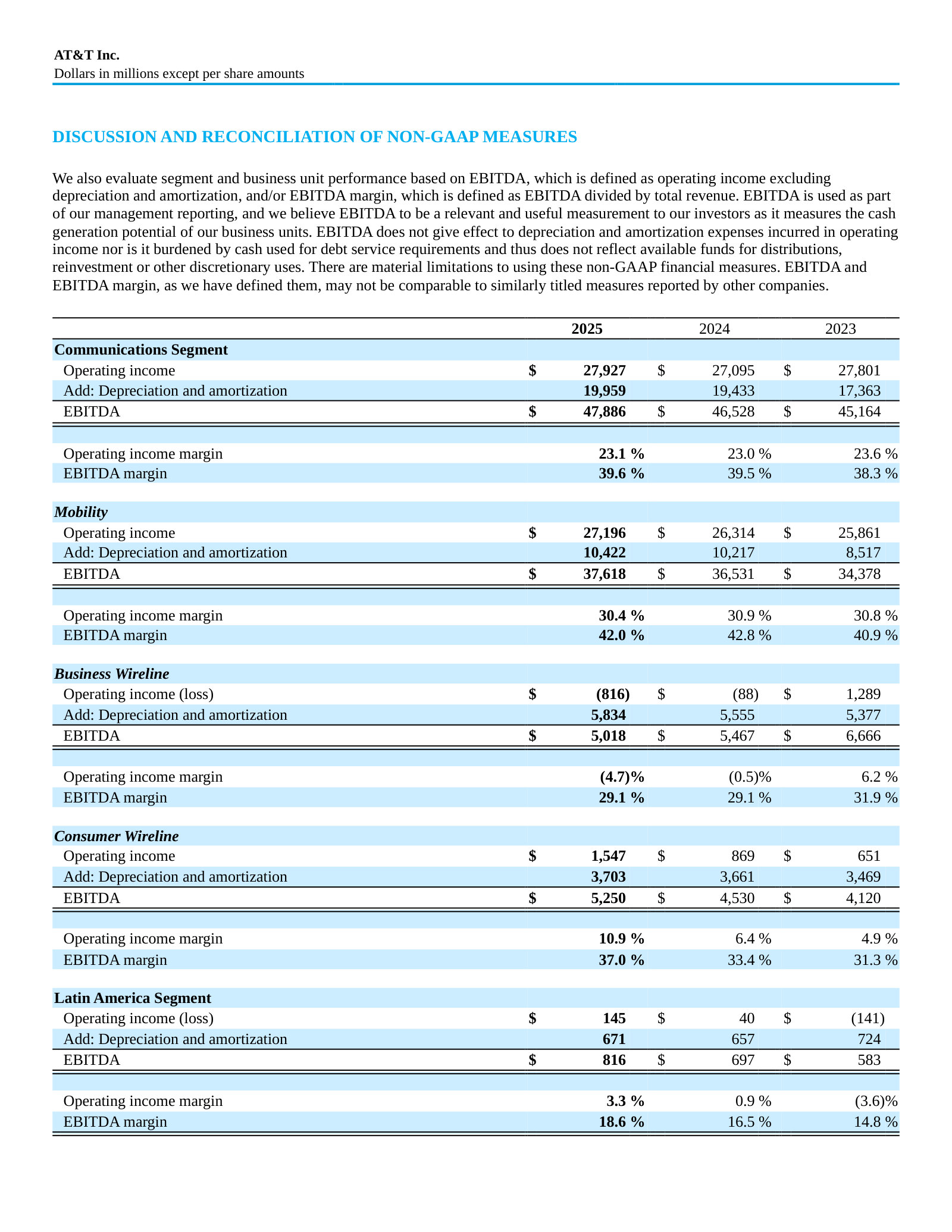
Business-unit EBITDA shows where the profit is: Mobility ($37.6B) and a recovering Consumer Wireline against a Business Wireline sliding into operating losses.
AT&T Inc. — FY2021 Annual Report (Form 10-K) — FY2021
The 'before' picture: AT&T as a telecom-media conglomerate with WarnerMedia and HBO Max, filed just as the Discovery spin-off that reversed the strategy was being signed. · Open the full document →
Item 1. Business — General (three-segment structure) — p. 5 · Read the full section →
Shows the abandoned strategy in management's own words — a 'telecommunications, media and technology' company, and the WarnerMedia–Discovery deal that unwound it.
AT&T defined as a media-and-technology company, and the May 2021 agreement to combine WarnerMedia with Discovery.
We are a leading provider of telecommunications, media and technology services globally. […] The WarnerMedia segment develops, produces and distributes feature films, television, gaming and other content in various physical and digital formats globally. […] On May 17, 2021, we entered into an agreement to combine our WarnerMedia segment, subject to certain exceptions, with a subsidiary of Discovery, Inc. (Discovery).
p. 6 · Read in context →
Item 1. Business — WarnerMedia Segment — p. 10 · Read the full section →
The scale of the media bet at its peak — ~23% of segment revenue and nearly 74 million HBO Max/HBO subscribers — before it was spun off in April 2022.
More annual reports
AT&T Inc. — FY2024 Annual Report (Form 10-K) — FY2024 · 163 pages · The transition year: a $4.4B Business Wireline goodwill impairment and Open RAN restructuring cut operating margin to 15.6%; first full year of the two-segment structure. · Open →
AT&T Inc. — FY2023 Annual Report (Form 10-K) — FY2023 · 175 pages · First 10-K to add the Item 1C. Cybersecurity disclosure and to account for DIRECTV as an equity-method investment rather than a consolidated business. · Open →
AT&T Inc. — FY2022 Annual Report (Form 10-K) — FY2022 · 181 pages · The pivot year: WarnerMedia spun off in April 2022 and reported as discontinued operations, leaving the Communications and Latin America segments that define AT&T today. · Open →